Friday, October 28, 2022

(Learning to Accept Failure)

There have been billions of dollars spent on the 'war-on-drugs', and, in the end, there seems to be no effect on the drug market. High school kids find drugs, especially marijuana easy to obtain. Despite spending billions on its eradication. The US has aggressively fought coca production in middle America, and yet it is still grown. It isn't really that surprising, in hind sight. You can grow a lot of drugs in a little dirt with some water. People can grow these plants. Illegalizing peyote is a little like Illegalizing wheat. It's impossible to enforce, extremely expensive. A lot harder than illegalizing something like a gun. It is also so much more pointless to pursue. Why would we try so hard to protect people from themselves? Especially when one of the side effects is getting people killed by drug cartels...?

It's a lot like basketball. The game of basketball has long since outgrown its rules. Professional basketball is played as a strange strategic contest against the rules for the last 10% of play time, not as a sport. There is something in the design of the game which leads to mono-stardom, not teamwork. If you are the kind of person who can throw a ball through the hoop no matter where you are on the court (and it helps if you are tall enough to throw it over anyone else's head), then that's all ya really need. You are unstoppable. Game over.

Someone might argue that I'm wrong, but the rules need to be changed. It's not working.

It is appropriate that it is an American Game. Invented at the Young Men's Christian Association in 1891. It closely resembles our broken politics. Our politics have become a depressing game, played more against the rules than for anything else. Except, worse even than pro basketball, there are only two teams to watch.

Each team has about 5 positions that anyone knows about, and only one that people care about. One super-star who becomes the face of the team. The locus of all their faith and hopes. The others are just there to support him 

For a long time, the players mill about, pretending to do their job. Pretending to compete in prowess and logic. And then, in the last seconds, the game heats up.

But instead of being a rational process, following the purpose of the game, our elections have become a strategy against the rules. It is bickering and arguing and placing falsified blame until the overwhelmed and underintelligent voting public pick the person they are least afraid of. Not the one who makes the most sense, or lies less. Often, the one who lied more successfully. Or had their timeout or fouled at the right time before that buzzer rings and its all over.

It is at this point we need to step back and think of what went wrong. What can be done better. Like the war on drugs, we must scratch off tactics which are not successful. We need to change rules that are easy for the cruel or immoral to misuse. Because, we can all agree, there is a lot of broken morals behind our broken politics, whatever side of the fence you are on.

being misuesed more than 

 of ra
Our elections, what is supposed to be the 
 Like the war on drugs, we need to think of a different strategy. Rework the rules of the game.


  Jeffrey A. Miron wrote a study that fou

Johnston, L. D.; O'Malley, P. M., Bachman, J. G. & Schulenberg, J. E. (November 30, 2005). "Table 13: Trends in Availability of Drugs as Perceived by Twelfth Graders" (PDF).Teen drug use down but progress halts among youngest teens. Monitoring the Future

 there have been numerous studies suggesting that we spend all the money we do on legal enforement o

Luck of the Evoloved

Survival is said to go to the fittest in little bits of conventional wisdom. It is what we have been taught since Darwin postulated his still controversial (and highly probable) theory. When times are easy, perhaps all but the lame or crippled will thrive; In hard times, such as famine, the strong may triumph of their weaker siblings; the best forager will eat; the lazy or simple will have trouble sustaining their bodies. It rings true enough to be acceptable. However, as with anything else in this crazy, mixed up, complicated reality we dwell in, this is too simple. There are others who will succeed along with the fit, perhaps even more often. And those are the lucky.

Luck is difficult to define and pin down. Like the soul, It doesn't really have a trace one can find. It is only loosely discussed as if it is a personified deity, or a part of your brain. Or, perhaps, it is mere happenstance. Those who are lucky today are lucky because someone else wasn't; but tomorrow, that can change, in the next hour that can change. In the next second. But, just as it is possible to flip 10 heads in a row (even probable if one sits with a coin for several days, flipping and flipping), eventually there will be that one who is successful for long enough that all of there accomplishments are due to chance. They got those heads. There are those who have stumbled upon success. The deer who happened upon the cherry bushes or the mosquito who bit while their victim was focused on a board game. They mayn't have been the strongest, but survive they did anyway.

And often this isn't really due to anything. If one walks by a mud puddle in the early summer, it will be pecked thoroughly by the killdeer and pigeons searching for arthropods and grubs. Most of them will be eaten, through no merit or lack-there-of on their end. And yet, their species is not extinguished. Many will survive. But it is hard to imagine it was on their merit. Their egg was only laid a millimeter off from the deadly beek of foraging bird.

Greed is Greed


Residents of communities with a higher-than-average standard of living, little poverty, and low crime give a smaller portion of their income to charity than those in less well-off communities, the Chronicle of Philanthropy reports.

In an analysis of giving behavior as measured against quality-of-life indicators in 2,670 counties across the United States, the Chronicle found an inverse relationship between a community's relative affluence and its charitable giving. Based on data from the How America Gives study, which shows share of income given by state, metropolitan area, county, and ZIP code in 2012, and the Opportunity Index, which scores socioeconomic well-being by county, the analysis found that counties in New England tend to have either moderate or high standards of living and low giving ratios, while those in Florida, the mid-Atlantic region, the Upper Midwest, and the West Coast have moderate standards of living and low giving ratios and counties in the Southeast tend to have either low or moderate standards of living and moderate giving ratios.

Notable among the outliers were counties in Utah and the southeast corner of Idaho, where both standards of living and giving ratios are moderate, with the exception of a few counties with low socioeconomic well-being and high giving ratios. Previous studies have found that people who are religious tend to give more, and both Utah and the Southeast have some of the highest rates of church attendance in the country.

The Chronicle notes that the giving ratios it calculated are based on data from taxpayers who itemize their charitable deductions, representing about 80 percent of all U.S. giving, but leave out giving by individuals who don't itemize, give more than the limit eligible for a deduction, or have wealth but no reportable income. In addition, because the giving ratio is calculated as a percentage of residents' income, the dollar amounts donated in high-income areas with lower giving ratios are often larger than those in low-income areas with higher giving ratios.

Nevertheless, the inverse relationship between socioeconomic opportunity and giving is "a compelling, counterintuitive finding" which pushes against assumptions that "places with higher scores would have higher rates of giving," said Russell Krumnow, managing director of Opportunity Nation, one of the nonprofits behind the Opportunity Index. People with lower incomes may be more willing to give, he added, because they identify more closely with the challenges faced by others in their communities. And that's a shame, because we "really need everyone's hands in this work…the work of expanding opportunity is everyone's."

Rebecca Koenig"A Mismatch Between Need and Affluence." Chronicle of Philanthropy 07/09/2015.

Subjects: philanthropy / voluntarism

People: russell krumnow

Organization: chronicle of philanthropy

Location: National


Re: Genetic / Inherited effects of stress


Psycological damage can quickly become chronic.
-"adverse childhood experience' -> attempted suicide + Early life stress (common enough to get its own acronym: ELS) -> pathophysiological (Pathology is the medical discipline that describes conditions typically observed during a disease state, whereas physiology is the biological discipline that describes processes or mechanisms operating within an organism) change in the CNS -> more vlunerable to stress later own = predisposed to mental and physical disorders.

Shit. Talk about a negative feedback loop.

Physical/sexual abuse effects mental health. Duh.
-Women with a history of sex abuse -> more likely to be depressive after a stressful live event than those without such history.
-Interesting: girls abused before 13 = PTSD or Major Depressive Disorder (MDD)
--girls abused after 13 = more likely PTSD


So: To let reality set in: Your body has it's physiology; that is, the way that it functions. Normally, that physiology is a healthy condition: your body's functions are essentially designed to work. For a long time.

However, there are times when the body's physiology, its processes, mechanisms, functioning, are not healthy. They are damaged, and can cause more damage. Like dirt in an engine slowly scraping away at finely tuned parts. We have a compound word for this: 'pathophysiology' (or, from another angle, 'physiopathology'). The processes and mechanisms operating within your organism--your body-- are diseased.

There are ways to affect the basic mechanics of an organism--its physiology. One of those ways is stress. Horrible experiences. Especially when those experiences are had during childhood. Pathophyiologists call this "Early Life Stress" or ELS. They can note all sorts of woeful things associated with ELS; such as marked increases in attempted suicide thoughout one's life, development of Post-Traumatic Stress Disorder or Major Depressive Disorder (PTSD or MDD, because everything must have its acronym)... with the MDD being more common with abuse at younger ages.

Meaning that the ol' adages are true: abuse leads to depression, which can lead to more abuse, and perhaps pattern-mimicking. The learning of bad habits.

In fact, there is evidence that Early Life Stress can alter brain structure. It's physical structure. Decreasing hippocampal volume and undermining, at a biological level, a person's ability to deal with shit.


-changes in hippocampal cytoarchitecture after chronic stress have been associated with changes in mood and cognition.

(stress-indiced change in behavior; ELS exerts acute and long-term effects on neuroendocrine, cognitive, and behavioral systems.)
-Lab animals: exposed to stress during development -> adverse short- and long-term cognitive disfunction + abnormal behavior
--associated with alterations in normal physiology and genetic regulation of HPA axis (Hypothalamic-Pituitary-Adrenal axis)
---adults sress response appear to be mediated (in part) thru effects of developmental stress in neural systems that deal with fear expression
----But also: quality of maternal care early in development may molify bad effects though the lifespan

Recap: Because this writing is excessively technical: Adult stress response depends on what came before it. Early Life Stress, especially, can wreck long-term (and also short-term) terror on an individual's ability to deal with stress. Their response, on the ontogeny (or every stage of life) if their existence, is affected negatively.

Chronic stress causes pathological damage.

There is evidence: lab animals abused by their scientist handlers then have cognitive and behavioral dysfunction. Scientists attribute some of this to alterations along the Hypothalamic-Pitutitary-Adrenal axis in the brain.

The good news: good mothering can make up for this. A bit.

You are here:
►Trauma exposure and neglect during both early life and adulthood substantially elevate adult risk for mood and anxiety disorders and alter hypothalamic-pituitary-adrenal (HPA) axis physiology. Exposure to a depressed mother either in utero or in the first months of life may also alter the HPA axis. - See more at: http://www.psychiatrictimes.com/ptsd/biological-consequences-and-transgenerational-impact-violence-and-abuse#sthash.TvZeiOI8.dpuf
--Analyze that.

Friday, August 7, 2020

Aug. 7 COVID - The US with its head in the sand

We are possibly the most selfish nation in the world. Riding my bicycle to work today, no one wants to give me any room on the road. How dare I slow them down. If I were a 10 ton piece of earth moving equipment, everyone slows down. Saw that yesterday. No one honked, no one tried to run him off the road. Because they would have torn their car apart.

A little bicycle? We can squish that guy without even having to file an insurance claim. All that matters is us in our own little lives. We have normalized greed to such an extent that we as a society don't even seem to care that we have one of the highest death rates to the global pandemic of Any country. Not just developed, rich nations (with hospitals and access to the internet... actually, wait, we are probably similar to Qatar in our access to hospitals and internet...), but of Any Other Nation on the Globe.

And we call ourselves the "Greatest Nation". Hubris. Pure and simple.

We are still top 10 in our inability to deal with COVID in all 8 categories the NY Times tracks: Cases, Case Rate, Recent Cases, Recent Case Rate; Deaths, Death Rate, Recent Deaths, Recent Death Rate. And it's mostly because of assholes (not everyone, but the assholes) in these states:

We are falling. Slowly. But are still worse now than we were in March when we started trying to care.

81 out of the 206 cases in my local community came in over July. That one month. That's almost half.  But fuck all if we'll actually DO anything about it.


Nope. Instead we're on the verge of letting our greedy, rich, 2nd home owners (immoral thing to have right off the bat. You should be ashamed.) have all the political control at a local level. Our "democracy" is a bloody joke. Wake up and fight for what little rights they've left you.

I realize I'm all doom-and-gloom. The good news, is that COVID is not as deadly as it once was. Not AS many people die. Still, The US has had over 7 thousand die in just the last week. Primarily because we're careless. Which is not what we want to hear, but it is what is true.

The rest of today's data:

Wednesday, July 22, 2020

COVID July 22 - guess what? We still suck.


Gunnison gained 19 cases over my weekend.

Meanwhile, a group of assholes from Texas and Arvada formed a Super PAC insisting that they have more rights to property than my community and I have to health and life. And by God they are going to come traipsing all over this county they don't ACTUALLY live in because they have money. Fuck everyone else. We're rich we have rights you don't.

It's time to close down again. Kick the assholes out.

We deserve to be 8th in the world in Cases. We deserve to be 9th in deaths. Don't worry, we'll get their soon. We are top 10 in every statistic the New York Times tracks. Our tendency to export pain and devastation to everyone else in the world, spread Pandemics around the globe despite easy to understand evidence, is hurting us right now. If not the most, than close.

As a bonus, Here's a map that shows what states should be exiled from the Union. They are in red.

Saturday, July 18, 2020

July 18 COVID race

It has been a while since our last check in with the Great Race to the Bottom. While the New York Times gets better and better at creating The Best Source for Coronavirus Information, the US is holding "strong": 1st in total cases by a mile (though Brazil is catching up), 1st in cases in the last 7 days, back to 10th in the world for cases per person (my primary statistic), and 6th in the world for cases per person in the last 7 days. We are 1st place in most deaths, are 2nd behind Brazil for most deaths in the last 7 days, 10th for deaths per person in the world and tie for 9th for most deaths per person in the last 7 days.

Good work.

I guess the death rate has dropped considerably and no one is worried anymore.

If we go back to school, maybe we can be #1 in every statistic!


If you're wondering where our numbers are coming from, the statistics above are the states with the greatest caseload per person in the last 7 days. Florida is "winning". Making good on all the jokes the world tells about them.

Last time I reported (7/09), Gunnison was at 125. A few days ago, I checked Gunnison's statistic, it was 127. Now we're at 130, and have a lot of pending tests out. I think one of them was from my place of work. It's getting closer and closer to home again. Tourism! The Most dysfunctional of all dysfunctional economies. Even though we have mask laws in place in the state, the tourists are coming from Many of the states above: Texas, Arizona, Alabama... 

Don't be an asshole. Stay home.

Thursday, July 9, 2020

July 9 COVID race


I have a friend who thinks this virus has been in the US since last August. The data doesn't support this claim very well, and the bump in overall deaths doesn't either. It is very difficult to tell when it first arrived, but we can easily read the effect. The requirement is that you have to believe the global medical community, and realize that it is impossible to run a conspiracy at this magnitude. "Plandemic" is dumb. And impossible. 

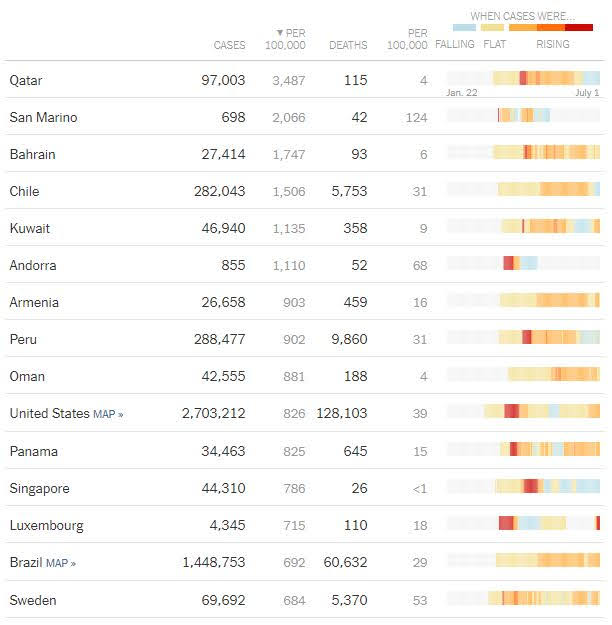
In the week since our last check in, the race has been heating up. Qatar has gained 0.2%, which used to seem like a lot. San Marino hasn't moved in weeks, so Bahrain is inches away from passing them as they shoot into the 2% club. Chile is thankfully slowing down, Kuwait is not. They have both gained about 0.1% in a week, it will take Kuwait a long time to catch up, if at all. They probably will not. I wish them the best. Andorra has figured this out. If they maintain the course, they are done. Nothing's happened for a long time.

Oman jumped from 9th to 7th (Armenia and Peru) gaining a little more than 0.1%. Panama jumped Peru and the US. We aren't slowing down our newest climb, but we have so many people it'll take us a while to move. And to slow down. And Brazil, our most tenacious new competitor jumped into 12th place, right behind the US, also gaining about 0.1%, but a little heaver 0.1% than ours in the US. If they pass us up, they will be hard to catch. Our wildcard is Arizona and Florida, which are both aiming to have more disastrous curves than Qatar itself.


Will Brazil win the title from Darth Drumph of Worst Government Ever?

Not really, I suppose. Our Darth has so many other impressively terrible qualities. So does theirs. We'll both overtake Peru by this time next week, leaping into the 1% club. We'll pass Andorra by the end of the month, as will many others.

Meanwhile in Tourist central Gunnison, we gained 2 cases in the last week. I checked yesterday, so we haven't grown since the 7th. That we know of yet.

Thursday, July 2, 2020

July 2 COVID


Kuwait overtook Andorra, Armenia overtook Peru, and Brazil overtook Sweden. The US is 1/4 of the way to shooting through the 0.8% club and into the 0.9% club. With no signs of slowing the outbreak, we'll join the 1% club in a few short days. With Peru's new cases dropping, we're likely to overtake them soon, though it'll take us a little while to overtake Andorra. Oman and Armenia are out of our reach at the moment, until we manage to turn our rate red... which I hope we can't quite do.

Wear a mask.

Tuesday, June 30, 2020

June 30 COVID


I'm moving my data source to the NY Times. They have the best data dashboard I've found for the CoronaVirus, and it is improving, or I'm noticing more about it. Not as much a fan of their rate graph (I like the simple line more) and they don't calculate "French Guinea" (like Wikipedia and Google), or Mayotte. Both of which are really old French imperial colonies / regions in Africa. I would guess that the count for "French Guinea" is included in "Guinea" for the NY Times, which has only 0.043% case-rate at the moment. I am not sure where Mayotte is counted. If you include them, the US is still in 12th place in the world. Without them, we're in the top 10.

At NY Times, you can compare death rate too! Which is morbidly exciting. We're in 9th place, with 39/100,000. 

The NY Times estimates numbers differently. They have us at 0.796%, where Wiki has us in the 0.8% club, but it is a small difference. Most countries, except Latin America, seem to have a smaller percent at NY Times.

A test came back positive in Gunnison on Sunday, Monday, or today. And I have friends worried they have contracted it despite their very best efforts. Tourism continues to spike here, as people make the less ethical, more selfish decision to travel around during our most boring Armageddon.

It is a time of great stress without healing. 

Stay strong.

Louisiana and Arizona are our 2 states with growing caseloads that are now in the "top" 10 for case rate. From someone in your destination playground: if you live there, please stay home.


Thursday, June 25, 2020

COVID June 25: It's getting a whole lot worse. Thanks for that.


Many upsets over the last 4 days, though none in the top 7. Little French Guiana has shot into 8th place with the small caseload of 2.5 thousand. Despite major surges in the US -- putting us back into the NYTimes list of countries where cases are rising, and posting our new record of about 38k new cases yesterday, and having about a quarter of all known deaths -- we have fallen to 13th place.

That isn't good news, globally, or even locally. It means that in addition to French Guiana and Oman have surged into the runnings, and Armenia has passed us again. Despite the reality that cases are only getting worse here in the US. The Pandemic is becoming more Pan as Latin America and even Africa are experiencing surges in cases.

And still we have a great deal of deniers in our country... which is a constant source of amazement to myself, as well as depression.

You can see on these standing for the 1st time Brazil, which is set to be our real competitor for most shit-headed country with many, many people relying on them to make wise decisions. Along with the US, they have 1-2 orders of magnitude more cases, and still have a high case rate. Which is pretty unique in the world. And along with the US, they have a pretty ridiculous government. Still, they are only in the 0.5% club, which we left about 2 weeks ago.

6 countries in the 1% club. The top 13 are all in the 0.7% club.

The states which should have restricted travel, since cases are rising and shouldn't go out infecting the rest of us (in a general order of importance, sorted by case rate, and steepness of the recent spike): California, Texas, Florida, Arizona, S. Carolia, Oklahoma, Utah, Arkansas, Oregon, Georgia... Louisiana, Ohio, Tennessee, Alabama, Washington, Idaho, Alaska, Hawaii, and Montana. Colorado is doing alright at the moment, but expect that trend to begin changing in a week or two: We are open for tourism, which is a great way to keep this thing going and get back to shutting down the country. 

In Gunnison, we have gone from 118 positive tests to 122. 4 new cases in 4 days. Which is alarming because we prior to my weekend, we had about 4 cases in 4 weeks. That is a alarming trend. Tourism is set to hit us hard for a second time in this one little year.

Think we'll shut down again? Or continue to compete for this sad championship?


Saturday, June 20, 2020

June 20 COVID


After a break for Juneteenth, Gunnison has somehow lost a case... Makes me question that data just a bit. The top 10 keep their standings for the last 2 days, the US making subtle gains on Singapore. Our caseload is more and more on the rise.

Thursday, June 18, 2020

June 18 COVID


The US has battled it's way back into 10th place! Passing Luxembourg with 0.669%! What a major upset. With the 7 day average of new cases is higher than it has been since the 11th of May in the US, they are unlikely to pass us back. Our growth trend is becoming more clear. Even considering better testing, the US may be in for another shutdown due to the virus unless our treatment can improve mightily and we can get our death-rate to continue to drop. Four our sake, I hope our caseload doesn't get back up to 30k cases per day, but I'm not optimistic. There is a treatment which has been successful in Europe... But here in America, most of us can't go to the doctor to try. Yay for the "Land of the Free (to get sick and die)". That's your most protected right here. Enjoy it.

Sadly, Chile has its own upset: jumping two places to find itself in 4th place. There are now 6 countries in the 1% (or more) Club. Worse, Peru's death rate is double Chile's. 

Wednesday, June 17, 2020

June 17 COVID


The trend is finally looking clear. About 4 weeks after Memorial Day (which seems understandable: it takes up to 2 weeks for symptoms to show, and then it'll be a few weeks before those symptoms travel around a little) and as the US opens up, the caseload is starting to rise.


The global standings haven't changed among the top ten, but poor Qatar has breached the 3% club.

The plague continues. In the US, where there's little consistency, we are having a lot harder time dealing with this virus than Europe. Or cultural father and nations with democracy and capitalism. They are figuring it out, the US cannot. I wold love to see this graph again in 2 weeks to see if our death toll begins to trend back up as well.

I hope not. But I suspect so. It is beyond time to start asking if we can do better.


The good news, is that there is a treatment that seems to be working. Perhaps we won't rebound. Thanks to... Europe.

Tuesday, June 16, 2020

June 16 COVID


Over my weekend, my town of Gunnison added a case. The last time I caught an added case was on the 10th (Gunnison reported it on the 9th or earlier), so it's been about a week since our last positive test.

Since last weekend, Qatar has jumped 0.2%, and is now one to two days away from busting into the 3% club. A club of one. For now. However, their curve is flattening, which is more than can be said for the US, which has been dealing with this since March and seems to be getting worse at it every day.

Peru has passed Singapore, probably for good, into 8th place, but that has been the only upset in the last 3 days.

The US is still sitting comfortably in 11th place, at 0.65%. Belarus, behind us, gained about 0.03% over that time and we gained about 0.02%. We both seem to be holding fairly flat, though Belarus seems to be improving, somewhat, while the US appears to be on the verge of its next spike. Which makes sense in the overall picture. When you drill down, we still have a large number of states reporting spikes, and everyone's starting to travel around for fun.

Thanks for that.

Expect "great" things from this behemoth competitor: Even with 2.1 MILLION cases (a full ORDER OF MAGNITUDE more than its closes competitor and about 1/4 of all global cases) It may be on the verge of shooting up past the 0.7% club and into the 0.8% club and seems to have the goal of reporting a full 1% of it's people affected by the virus.

I'm feeling particularly cynical today. What with Texas, California, Alabama, Utah, Arkansas, the Carolinas, Florida, and our own Costilla and Montezuma counties growing... and especially Arizona, where the Governor insists: 'if I close my eyes, it doesn't exist! if I plug my ears it ceases to exist... how come only 3 month-olds seem to know about this? It's great!'

If you want to open up: be strict on masks. It's that damn simple.

Check in tomorrow, it will probably be much the same.

Saturday, June 13, 2020

June 13 COVID


Bahrain skips ahead of Andorra, finally displacing them from their long-held 3rd place spot. Soon, Mayotte will make it to the 1% club. Cases are slowly coming back up in the US, though we are still hovering around 20k cases per day, never having dropped, our worse-case states are doing alright... and several of our warm-weather states seem to be getting complacent. The Carolinas, Utah, Arizona, and California are seeing rising trends, preventing the country from coming down. Wait for this time next week to see what the change is.

Gunnison remains fine... Still holding steady at 117 positive tests. Protect yourself against tourists who may carry this disease from less careful places to areas which have kicked the virus out.


Good Chapters: